




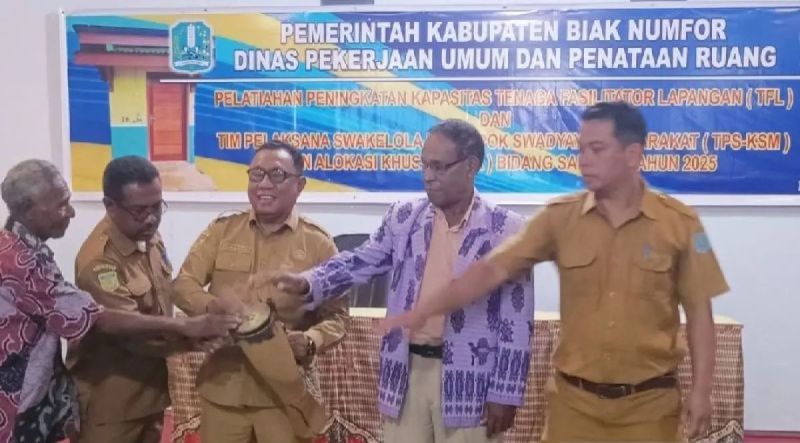
Biak, Papua — In an effort to strengthen local human resource capacity in the development sector, the Biak Numfor Regency Government held a training program for 24 field supervisors, all of whom are Indigenous Papuans (OAP).
The training focused on enhancing participants’ technical skills in monitoring and supervising community-based sanitation projects.
The two-day program, held from Monday to Tuesday (October 13–14, 2025), was officially opened by Acting Regional Secretary of Biak Numfor, Z.L. Mailoa. In his remarks, Mailoa emphasized that building the competence of local supervisors is crucial to ensure effective, transparent, and community-oriented project implementation.
“Supervisors must understand not only the technical aspects of their work but also their social responsibility in assisting communities to manage sanitation facilities,” he stated.
Meanwhile, the Head of the Public Works and Spatial Planning Office (PUPR) of Biak Numfor, Frans Watimena, explained that participants received materials on policy and technical guidelines for developing bathing, washing, and toilet (MCK) facilities, as well as clean water systems for low-income communities.
He noted that the success of sanitation projects at the village level largely depends on the ability of field supervisors to provide consistent assistance and monitoring.
This training initiative is part of the 2025 Special Allocation Fund (DAK) program for sanitation and clean water infrastructure. Through this program, the Biak Numfor Government aims to empower Indigenous Papuans to play an active role in maintaining environmental quality and supporting inclusive local development.

