



JAYAPURA – Strengthening basic education services in the border area is a joint concern between the Papua Provincial Government and the Women’s Solidarity for Indonesia (Seruni) of the Red and White Cabinet. The commitment was realized through a humanitarian visit to Mosso State Elementary School, Muara Tami District, Jayapura City, as an effort to support the improvement of the quality of education and the welfare of the people on the border of the Republic of Indonesia–Papua New Guinea.
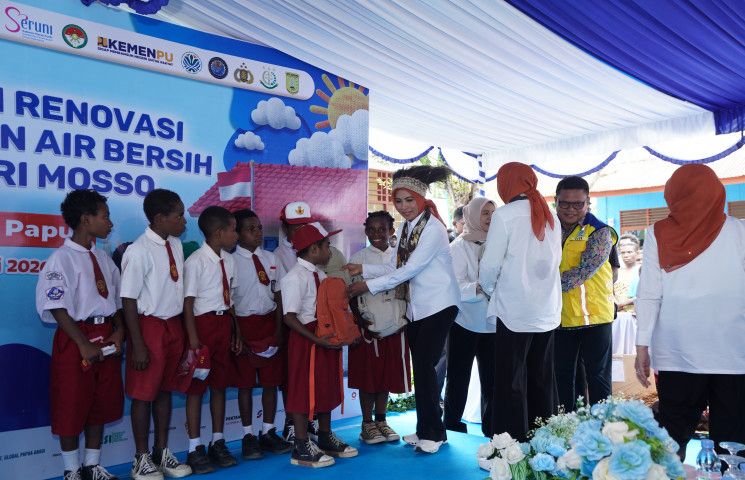
This visit is combined with the distribution of social assistance as well as a direct review of the condition of school facilities and infrastructure. The assistance handed over includes food packages, school stationery, clean water facilities, and a number of educational support facilities that are expected to support the smoothness of the teaching and learning process.
The handover of aid was carried out directly by the Head of Section IV of the Red and White Cabinet, Mrs. Sri Suparni Bahlil, as a form of concern for the community and the world of education in the border area. In his speech, he emphasized that the visit aimed to see directly the condition of the community and schools in Papua, especially in the border area.
“I hope the assistance given can help meet basic needs, especially access to clean water, as well as support the smooth teaching and learning activities for children at Mosso State Elementary School,” said Mrs. Sri Suparni Bahlil.
This series of activities was also attended by the Governor of Papua Matius Fakhiri, the Head of TP-PKK of Papua Province, as well as elements of the Regional Leadership Coordination Forum (Forkopimda) of Papua Province and Jayapura City. The visit was also marked by planting trees in the school yard as a symbol of support for the creation of a healthy, green, and sustainable learning environment.
The head of Mosso State Elementary School, Stevanus Mandowen, explained that the school currently has 98 students, consisting of 85 children from Mosso Village and 13 children with Papua New Guinea citizenship. There are 11 educators, with details of six state civil apparatus teachers (ASN) and five Government Employee teachers with Employment Agreement (PPPK).
“Some classrooms have been rehabilitated, but the arrangement of the school yard still needs attention to better support children’s learning activities,” explained Stevanus Mandowen.
Meanwhile, Papua Governor Matius Fakhiri expressed his appreciation for the support and collaboration of Seruni Kabinet Merah Putih in strengthening education services and fulfilling the basic needs of the community in the border area.
According to him, the synergy between the government and various elements of the community is the key to improving the quality of Papua’s human resources, especially in border areas that have geographical challenges and limited facilities.
This activity is expected to be a sustainable step in encouraging equal education and improving the welfare of border communities, as well as emphasising the state’s presence in ensuring the right to education for all children of the nation without exception.