



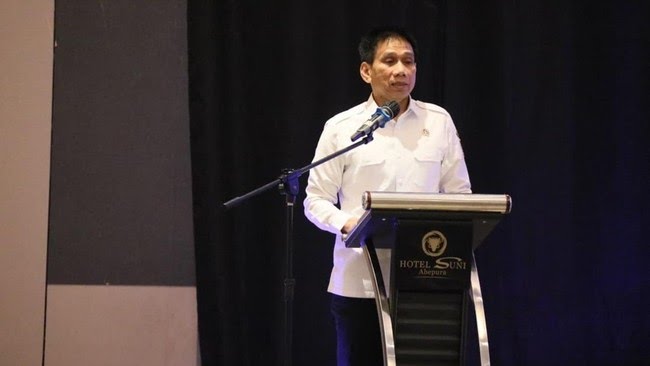
Jakarta – Indonesia’s Deputy Minister of Home Affairs, Akhmad Wiyagus, reaffirmed the government’s strong commitment to addressing public health challenges in Papua, particularly HIV/AIDS, tuberculosis, malaria (ATM), and leprosy. He stressed that beyond budgetary support, effective handling of these issues requires stronger alignment between central and regional government programs, as well as the strengthening of human resources.
“We know that health issues are a mandatory government responsibility directly tied to basic public services,” Wiyagus said in a statement on Tuesday (April 28, 2026).
He delivered the remarks during the Technical Coordination Meeting on the Acceleration of the Elimination of AIDS, Tuberculosis, Malaria, and Leprosy in Papua, held at Hotel Suni Abepura, Jayapura Regency, Papua, on Tuesday (April 28).
On the occasion, Wiyagus emphasized that regional governments must place the health sector as a top priority. He highlighted that strengthening human resources remains a critical component that must be continuously developed, in line with the national policy direction under Asta Cita.
According to him, the success of disease control efforts in Papua largely depends on the readiness and capacity of healthcare workers on the ground, including in early detection, treatment, and public education.
Wiyagus also underlined the central government’s seriousness in improving public health outcomes in Papua. In addition to funding support, the government, through the Ministry of Health, has deployed a special task force to handle ATM and leprosy cases in the region.
“This large team has been brought here to assure all people in Papua that the central government is very serious about addressing these health issues,” he said.
He outlined key responsibilities for regional governments, including coordinating intervention programs, allocating budgets, accelerating case detection, ensuring effective treatment and prevention, and mitigating the psychosocial and economic impacts on patients.
Furthermore, Wiyagus noted that Papua holds a strategic role in supporting national development, making it essential to address ongoing health challenges through cross-sector collaboration.
“All parties must be involved through a pentahelix approach—the central government, regional governments, academics, and NGOs must all take part,” he said.
He also stressed the importance of educating the public about ATM and leprosy, noting that better understanding can encourage early treatment and reduce social stigma.
“What matters is early and specific, educational handling, so that people can easily understand,” he added.