



NABIRE – The West Nabire District Government, Nabire Regency, Central Papua, is preparing a Mandatory Farming Movement as a strategic initiative to encourage residents to utilize agricultural land while strengthening food security and improving family welfare.
Head of West Nabire District, Osea P. Wakei, said the program is designed to encourage every family to engage in farming activities that can serve as a source of income while also meeting household food needs.
“We are preparing the Mandatory Farming Movement so that every family in West Nabire District can own and manage agricultural land. We hope agriculture will not only serve as a source of food but also help improve family incomes,” Osea said in Nabire on Thursday.
He explained that the initiative was developed based on the significant agricultural potential in West Nabire that remains open for further development. The district government considers agriculture to play an important role in strengthening the local economy while supporting food availability at the community level.
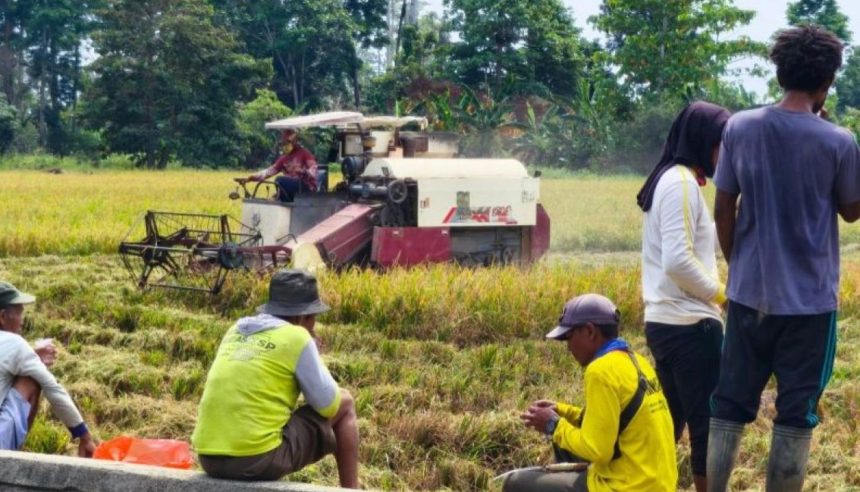
Agricultural development is also being directed toward improving the quality of food consumption and nutrition among residents. One of the initiatives receiving attention is the development of biofortified rice, which held its first harvest on July 29, 2026, following its initial planting in April.
Osea welcomed the development of the rice variety, saying it could provide direct benefits to the community, particularly in meeting nutritional needs and supporting government efforts to reduce stunting.
“We welcome the development of biofortified rice because its benefits can be directly felt by the community. In addition to increasing food production, its nutritional content can support efforts to address stunting, enabling people to grow healthier and stronger,” he said.
Currently, there are two Indigenous Papuan (OAP) farmer groups in West Nabire, each consisting of more than a dozen farmers. The district government also recorded more than six other farmer groups that could potentially be involved in implementing the Mandatory Farming Movement.
Despite its considerable potential, agricultural development in West Nabire still faces several challenges. One of the main obstacles is limited water availability during the planting season, which affects agricultural productivity.
Osea said irrigation problems were among the factors preventing farmers from achieving optimal harvest yields. Therefore, the district government hopes that improvements and rehabilitation of irrigation infrastructure can continue to support sustainable agricultural activities in the area.
Further support for the agricultural sector is also being provided through the rehabilitation of the Kali Bumi Weir irrigation network. The Papua River Basin Organization (BWS Papua) is currently rehabilitating approximately 2.8 kilometers of the primary irrigation canal in West Nabire District.
Muh Syahril, the Commitment-Making Official for Irrigation and Swamps Region I at BWS Papua, explained that the rehabilitation work is aimed at improving the reliability of the irrigation network, which had not undergone comprehensive repairs for several years.
The physical rehabilitation work is targeted for completion by the end of November 2026. However, water flow will be gradually restored starting in late August 2026 to ensure that farmers’ water needs continue to be met while construction work is underway.
With the Mandatory Farming Movement supported by improvements to irrigation infrastructure, the West Nabire District Government hopes the area’s agricultural potential can be managed more effectively, creating new sources of income, strengthening food security, and improving community welfare in a sustainable manner.