



Since the early days of Indonesia’s independence, Papua has been an integral part of the national vision to unify all former Dutch East Indies territories under the Unitary State of the Republic of Indonesia (NKRI). The long process of Papua’s integration into Indonesia involved not only high-level diplomacy but also political struggles that put national sovereignty on the world stage. One of the historical milestones that affirmed Papua’s status as a legitimate part of Indonesia was the 1969 Act of Free Choice (Pepera), later reinforced by the United Nations (UN) decision.
The Beginning of the Papua Dispute
After Indonesia’s Proclamation of Independence on August 17, 1945, all former Dutch colonial territories were declared part of Indonesia. However, the Netherlands retained control over Papua and attempted to establish its own government in the region. This move triggered tensions between Indonesia and the Netherlands, culminating in 1961 when the Dutch sought to internationalize Papua’s status by supporting the establishment of the “West Papua State.”
Tensions escalated with Indonesia’s military operation, Trikora (Tri Komando Rakyat), launched by President Soekarno on December 19, 1961. The operation aimed to reclaim Papua from Dutch hands and reaffirm Indonesia’s claim over the region. Amid increasing international pressure, the United States intervened as a mediator, leading to the signing of the New York Agreement on August 15, 1962.
The New York Agreement and the Act of Free Choice (Pepera)
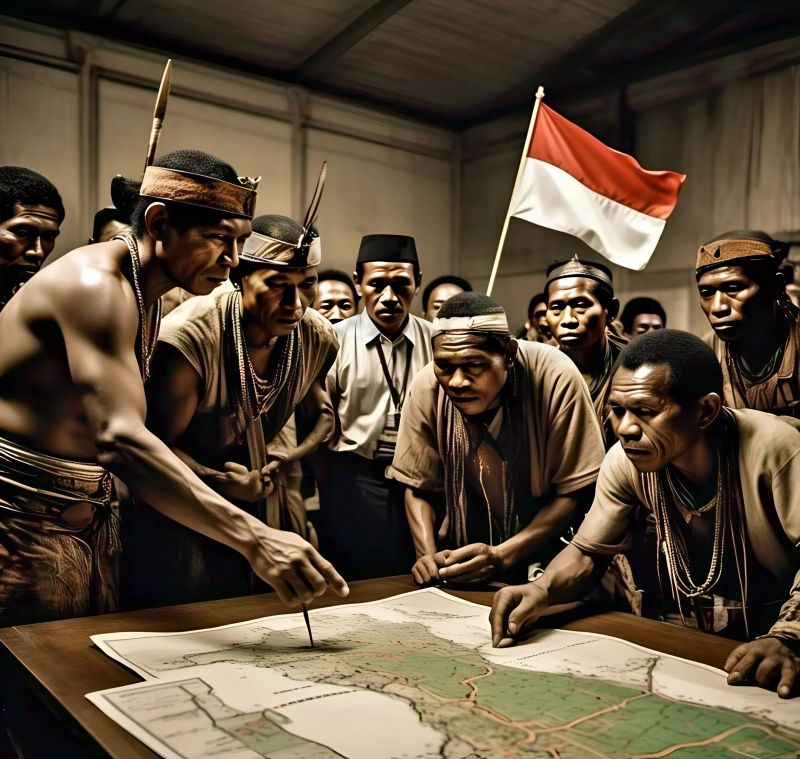
The New York Agreement was a pivotal moment in Papua’s history. It stipulated that the Netherlands must transfer Papua’s administration to the United Nations Temporary Executive Authority (UNTEA) before ultimately handing it over to Indonesia on May 1, 1963. A key provision of the agreement was Indonesia’s obligation to conduct the Act of Free Choice (Pepera) to allow the Papuan people to determine their own future.
Pepera was conducted in 1969 under UN supervision. The process involved 1,026 representatives from various regions in Papua, who voted through a consensus mechanism. The results showed unanimous support for Papua’s integration into Indonesia. This decision was subsequently accepted and ratified by the UN General Assembly through Resolution 2504 on November 19, 1969, recognizing that the Pepera process had adhered to the agreed-upon terms.
International Legitimacy and Papua within NKRI
With the UN’s ratification of the Pepera results, Papua’s status as part of Indonesia received international recognition. This decision reaffirmed that Papua had legally become part of NKRI and closed the door for those seeking to challenge the legitimacy of its integration on the global stage.
However, to this day, some narratives continue to dispute the Pepera results with various claims. Nonetheless, from an international legal perspective, the UN’s decision stands as strong evidence that Papua is an inseparable part of Indonesia. The Indonesian government continues its efforts to improve the welfare of Papuans through various policies, including special autonomy, infrastructure development, and economic and social empowerment.
Papua Forever Indonesia
History has recorded that Papua’s integration into NKRI was not the result of unilateral coercion but rather a legally and internationally recognized process. With the Pepera and the UN decision, Papua became part of Indonesia with a solid legal foundation. Now, the greatest challenge lies in developing Papua to be on par with other regions in Indonesia in terms of development, welfare, and social progress.
Papua is not only part of Indonesia on the map but also in the nation’s soul and spirit. History has affirmed that Papua will forever remain in the embrace of the Motherland as an inseparable part of the Unitary State of the Republic of Indonesia.